
Last Updated: October 25, 2026
Quick Summary
Quartz, porcelain and solid surface are the best alternatives to marble bathroom countertops, because each resists water and stains without sealing. Quartz needs no sealing, porcelain adds scratch resistance, and solid surface is the most repairable option. Choose based on how hard your household is on surfaces.
- Quartz never needs sealing and shrugs off water and most household stains.
- Porcelain resists water, stains and scratches but has brittle edges needing specialist fabrication.
- Solid surface joints are bonded invisibly and light scratches buff out with an abrasive pad.
- Compact surface resists nail polish remover and hair dye without marking but costs more.
- Rank materials by repairability and maintenance first, then appearance, for lowest lifetime hassle.
Table of Contents
- Why Homeowners Look Beyond Marble Bathroom Countertops
- Quartz vs Marble Countertops: The Engineered Advantage
- Porcelain Bathroom Countertops: The Sleeper Hit
- Solid Surface Bathroom Countertops: Seamless and Repairable
- Durable Bathroom Countertop Materials That Handle Daily Life
- Cost, Lifespan, and Maintenance: Side-by-Side Comparison
- Choosing the Right Alternative for Your Bathroom Vanity
- Book a Free Consultation with Pro Kitchen & Bath
- Frequently Asked Questions
Why Homeowners Look Beyond Marble Bathroom Countertops
Marble is the finish everyone pictures in a luxury bathroom, and it is also the finish that causes the most regret. Marble is a soft natural stone: it etches when acidic products touch it, stains when oils and cosmetics sit on it, and needs sealing to slow water absorption. In a bathroom, where soap, hair dye, perfume and toothpaste land on the surface daily, that softness shows up fast. This guide from Pro Kitchen & Bath walks through the best alternatives to marble bathroom countertops, ranked by how they actually behave in a wet, high-use room rather than how they photograph.
The core tension is simple. Marble wins on appearance and loses on upkeep. The alternatives below close that gap in different ways, and the right pick depends on your budget, your tolerance for maintenance, and how hard your household is on surfaces.
Quartz vs Marble Countertops: The Engineered Advantage
Quartz countertops are engineered stone: ground quartz mixed with resin and pigment, pressed into slabs. The resin binder is why quartz shrugs off water and most household stains that would mark marble, and why it never needs sealing. That single difference is the whole argument in the quartz vs marble countertops debate.
Where quartz falls short is heat and sunlight. Resin can scorch under a hot styling tool, and some quartz colors fade with prolonged direct sun, which matters if your vanity sits under a window. Veining is printed or blended rather than geological, so a quartz slab can look uniform in a way real stone never does.
Pros: no sealing, strong stain resistance, wide color selection, consistent slabs.
Cons: heat-sensitive, seams are visible, less unique than natural stone.
Porcelain Bathroom Countertops: The Sleeper Hit
Porcelain bathroom countertops are the option most homeowners overlook, and they deserve better. Porcelain is fired clay with a printed glaze, which means you get a marble-look surface with the veining of Carrara-style stone on a body that resists water, stains and scratches far better than marble does.
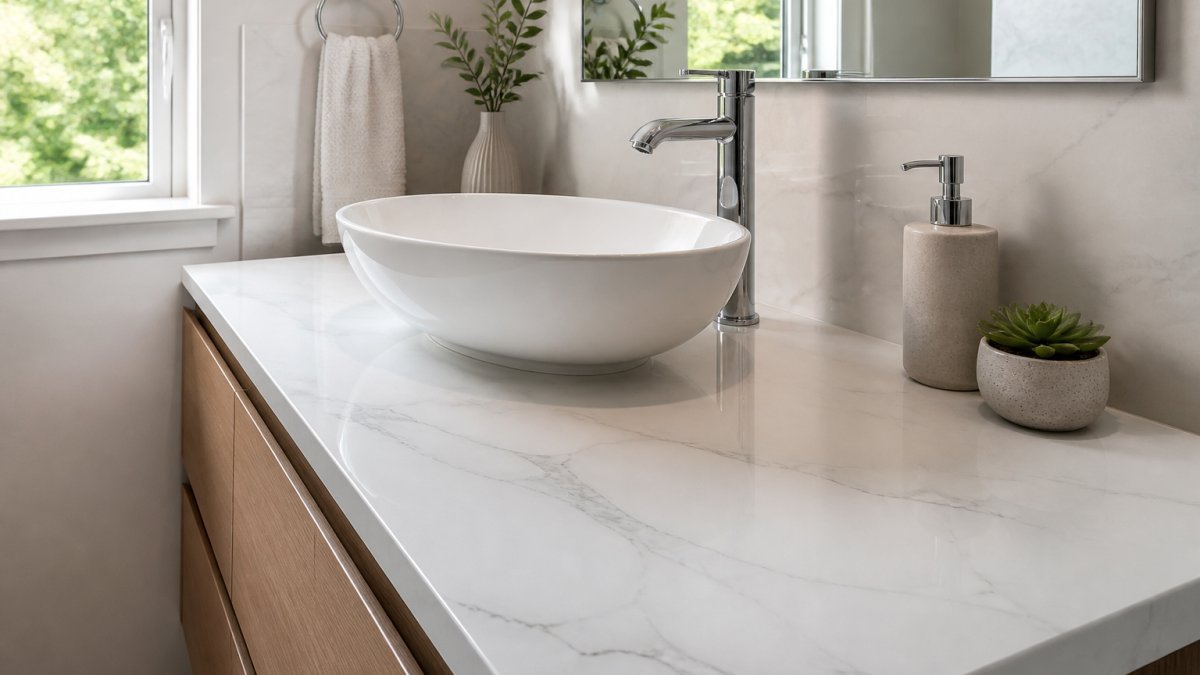
The catch is installation. Porcelain slabs are thin and brittle at the edges, so they chip if handled carelessly and demand an experienced fabricator for cutouts and mitred edges. In practice, that constraint is what keeps porcelain out of budget renovations.
Pros: excellent stain and scratch resistance, authentic marble appearance, non-porous.
Cons: brittle edges, specialist fabrication, can sound hollow underfoot.
Solid Surface Bathroom Countertops: Seamless and Repairable
Solid surface bathroom countertops, made from acrylic or polyester blends, are the practical choice for anyone who wants a seamless look. Joints are bonded and sanded invisible, sinks can be integrated into the surface, and light scratches buff out with an abrasive pad. No other material is this repairable.
The trade-off is heat and sharp impact. A hot curling iron left down will mark solid surface, and a heavy dropped object can chip it. It also shows scratches more than quartz under harsh light, though those scratches are easy to remove.
Pros: seamless joints, repairable, integrated sinks, warm to the touch.
Cons: heat-sensitive, scratches show, less stone-like than quartz or porcelain.
Durable Bathroom Countertop Materials That Handle Daily Life
Durable bathroom countertop materials share one trait: they tolerate moisture, cosmetics and cleaning products without needing constant attention. Most roundups discuss countertops as if they all live in kitchens, but a bathroom vanity is a different environment. It sees standing water from wet hands, splashes from the sink, hair dye and nail polish remover, toothpaste residue, perfume and alcohol-based skincare, plus humid air that never fully dries out in a small, poorly ventilated room. Judge any material against those conditions, not against a kitchen’s heat and knife risk.
Beyond quartz, porcelain and solid surface, a few others earn a place:
- Granite: strong scratch and heat resistance, and it handles water well once sealed, but it needs periodic sealing and its busy veining divides opinion. In a bathroom, the sealing schedule matters more than in a kitchen because humidity keeps the stone damp longer.
- Compact surface: a dense pressed material that resists water, stains and most cosmetics well, though it costs more and limits color choice. It is one of the few surfaces that shrugs off nail polish remover and hair dye without marking.
- Laminate: the affordable option, now available in convincing marble-look finishes. It resists stains and everyday splashes, but it can chip at edges and is not heat-proof, so a hot styling tool left down will mark it.
- Recycled glass: a distinctive look with good durability and solid resistance to stains and water, though color selection is narrow and fabrication options are limited.
- Soapstone and butcher block: character-rich but higher maintenance in a wet room. Soapstone needs oiling and can scratch; butcher block needs sealing against water and will swell if moisture gets into end grain.
A bathroom-specific point most guides skip: the products on a vanity are often the real threat, not water. Acetone, hair dye, benzoyl peroxide and some cosmetics can stain or etch surfaces that handle water perfectly well. Engineered surfaces and compact surface generally resist these best; natural stone and solid surface are more vulnerable, and marble is the most vulnerable of all. If anyone in the household uses these products daily, that single factor should outweigh appearance.
For wall finishes that pair with these surfaces, our guide to alternatives to traditional bathroom tile for walls covers the matching options.
| Material | Best For | Watch Out For |
|---|---|---|
| Quartz | Low-maintenance households | Heat and direct sun |
| Porcelain | Marble look with durability | Brittle edges, specialist install |
| Solid surface | Seamless, repairable surfaces | Heat marks, visible scratches |
| Granite | Heat and scratch resistance | Needs sealing |
| Compact surface | Cosmetics and stain resistance | Higher cost, limited colors |
| Laminate | Tight budgets | Chipping, heat damage |
No countertop material is truly maintenance-free in a bathroom. Even non-porous surfaces need prompt cleanup of hair dye and acetone, because the longer those products sit, the higher the chance of a permanent mark.
Cost, Lifespan, and Maintenance: Side-by-Side Comparison
Cost, lifespan and maintenance rarely line up the way homeowners expect, and the only honest way to compare them is on a consistent framework. The table below uses four criteria that matter in a bathroom: upfront cost tier, expected service life, routine maintenance, and whether damage can be repaired in place.
| Material | Upfront Cost Tier | Expected Service Life | Routine Maintenance | Repairability |
|---|---|---|---|---|
| Laminate | Lowest | Shortest of the group | Wipe clean; avoid abrasives | Poor, chipped edges are hard to disguise |
| Solid surface | Low to mid | Long | Wipe clean; occasional light sanding | Excellent, scratches buff out, joints invisible |
| Porcelain | Mid | Very long | Wipe clean; no sealing | Poor at edges, chips need a specialist |
| Quartz | Mid to high | Long | Wipe clean; no sealing | Limited, seams and chips are difficult |
| Granite | High | Very long | Periodic sealing | Moderate, chips can be filled, but color match varies |
| Compact surface | High | Very long | Wipe clean; no sealing | Limited, specialist repair only |
| Marble | High | Long, but appearance degrades | Sealing plus careful cleaning | Moderate, etching is permanent unless re-polished |
Two patterns stand out. First, upfront cost and upkeep cost move in opposite directions: laminate is cheapest to buy and cheapest to replace, while marble is priced as a premium material yet demands the most care of anything on the list. Second, repairability is the criterion most buyers ignore until something goes wrong.
Pricing for any of these depends on slab size, edge profile, cutout count and fabrication complexity, so we quote each project individually rather than publish figures that won’t hold across suppliers and regions. Budget overruns are a real fear in renovations, and our guide on how to avoid surprise renovation costs explains how to keep a countertop swap from ballooning.
If you want the lowest lifetime hassle rather than the lowest sticker price, rank materials by repairability and maintenance first, then by appearance. That ordering usually points to solid surface or quartz, not marble.
Choosing the Right Alternative for Your Bathroom Vanity
Choosing the right alternative comes down to three questions: how hard your household is on surfaces, how much upkeep you’ll accept, and what your vanity layout allows.
- Busy family bathroom: quartz or porcelain for stain resistance and easy cleaning.
- Tight budget: laminate in a marble-look finish, or porcelain if the budget stretches.
- Seamless, integrated look: solid surface with a bonded sink.
- Heat exposure near a window: granite over quartz or solid surface.
Installation constraints matter too. Vanity depth, backsplash height and sink cutouts all affect which materials a fabricator can work with cleanly. If you’re planning the wider project, our master bathroom renovation timeline shows how a countertop decision fits into the full schedule, and our bathroom remodeling services cover the installation itself.
Best for: homeowners who want the marble look without marble’s upkeep.
Skip if: you want a genuinely unique slab with natural variation, in which case sealed granite or marble may still suit you.
Book a Free Consultation with Pro Kitchen & Bath
The hardest part isn’t picking a material on paper. It’s knowing which one suits your vanity, your household and your budget once a fabricator looks at the actual space.
At Pro Kitchen & Bath, we’ve spent more than 25 years managing bathroom renovations from layout planning through trade coordination, so the countertop, sink and backsplash are chosen together rather than piecemeal. Every project is run by our team, owned and operated by Steve Vanadel, with the goal of high-standard workmanship that holds up. If you’re weighing quartz against porcelain or solid surface and want a straight answer, get in touch with our team to book a free consultation.
Frequently Asked Questions
Can you use marble for a bathroom vanity?
Yes, marble can be used for a bathroom vanity, but it requires careful maintenance. Marble is porous and sensitive to acids found in toothpaste, cosmetics, and cleaning products, so it needs regular sealing and prompt cleanup of spills. In a busy bathroom, that level of care can become frustrating. Many homeowners choose marble-look quartz or porcelain instead to get the appearance without the etching and staining risk.
Which countertop material looks most like marble?
Quartz and porcelain are the closest matches to marble’s appearance. Quartz manufacturers produce engineered stone with printed or veined patterns that mimic Carrara and Calacatta marble, complete with realistic veining. Porcelain slabs also offer high-resolution marble-look finishes. Solid surface materials can imitate marble but often lack the depth and variation of natural veining. For a convincing marble appearance with better stain resistance, quartz is usually the top choice.
Is quartz or porcelain better for a bathroom countertop?
Both work well, but they suit different priorities. Quartz offers a wide range of marble-look designs, is non-porous, and resists stains and scratches. Porcelain is extremely hard, heat-resistant, and impervious to water, but it can chip at edges and requires professional fabrication. For most bathroom vanities, quartz provides a better balance of durability, appearance, and ease of installation. Porcelain is a strong option for homeowners who want a sleek, thin profile and maximum moisture resistance.
Which bathroom countertop material is easiest to maintain?
Solid surface and quartz are the easiest to maintain. Solid surface is non-porous and scratches can be sanded out, while quartz requires no sealing and resists stains. Porcelain is also low-maintenance but edges can chip. Marble and granite need periodic sealing and careful cleaning. For a busy household, quartz or solid surface reduces upkeep and keeps the vanity looking new with minimal effort.
Marble looks beautiful until the first hair dye stain. If you want a bathroom countertop that keeps its finish without constant sealing and careful cleaning, we can help you choose the right material and install it properly. Get started with Pro Kitchen & Bath and book a free consultation to plan a bathroom that looks right and holds up.
